India
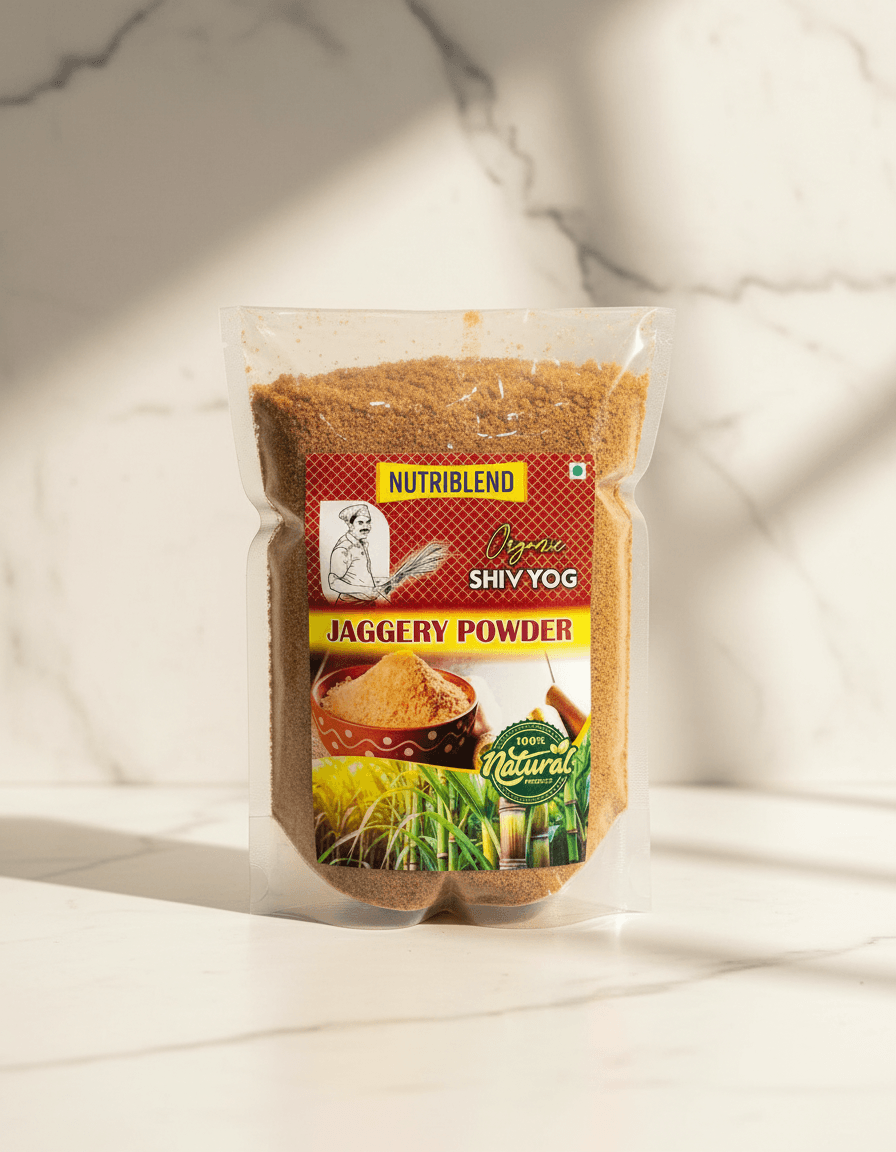
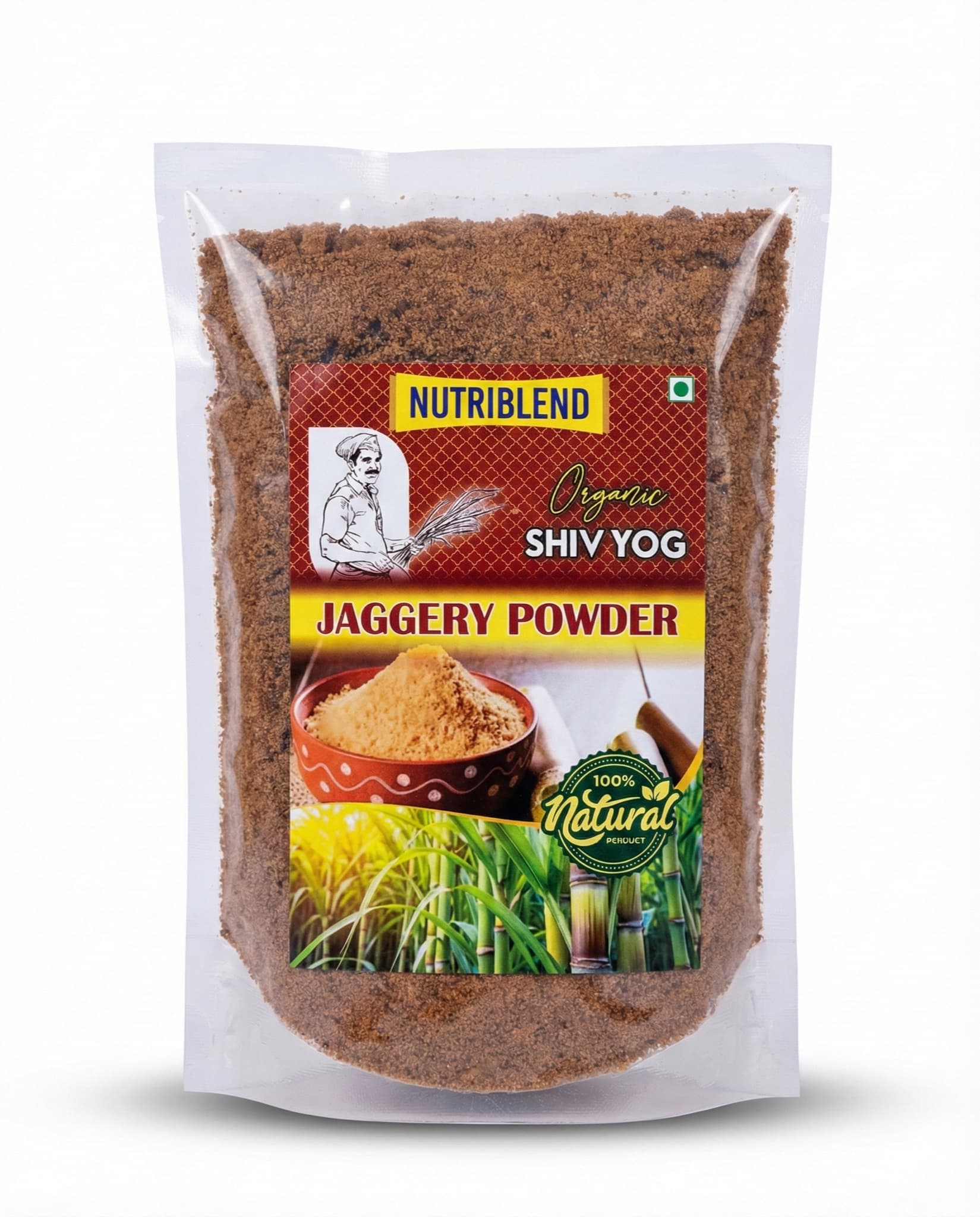
Organic ShivYog Gud 1kg Slab
Pure Chemical-Free Jaggery · Natural Sweetener for Cooking & Tea
Pairs well with
The harvest
Grown in India.
A high-purity 1kg slab of organic jaggery prepared using traditional methods. Completely chemical-free, nutrient-rich, and naturally sweet, ideal for tea, sweets, cooking, and everyday nutrition
Why this pack
The good part of the harvest.
- 01Organic & chemical-free
- 02Unbleached: keeps the dark molasses fraction
- 03Natural sweetener alternative to sugar
Up close


Why this oneRead the full story
Real gud is dark
Sugarcane juice boiled down honestly does not produce a clean golden-yellow block. It produces something between dark amber and near-black, uneven in tone, with a mineral edge under the sweetness.
The golden jaggery on every shop shelf is golden because someone made it that way.
What usually gets added
Boiling cane juice throws up a dark scum of field soil, cane fibre and plant proteins. Traditionally you skim it. Skimming is slow, costs labour and loses some sugar, so most commercial units clarify chemically instead.
Sodium bicarbonate is the mild end. Sodium hydrosulphite — hydros powder — is the real problem. It is an industrial bleaching agent used in textiles and paper, it is not a permitted food additive for jaggery, and it is used widely anyway because it is cheap and produces that uniform bright yellow in one step.
The colour people are trained to read as good jaggery is usually the signature of the bleach.
We clarify with okra
Boil down bhindi and you get a thick mucilage — a long-chain polysaccharide. Stirred into the heating cane juice it behaves like a net, binding the suspended solids into clumps cohesive enough to rise as a single scum layer that lifts off cleanly.
Same job as the bicarbonate. Completely different result. A chemical clarificant strips colour along with the dirt, taking the molasses fraction — the iron, magnesium, potassium and the flavour — with it. Okra mucilage lifts the dirt and leaves the minerals behind.
That is why this comes out dark. It is not a style choice.
It is slower, costs more labour and yields slightly less per batch. Those three facts are the entire reason the industry moved to hydros.
Test it yourself
Drop a piece in a glass of water. Real jaggery sinks and dissolves slowly, leaving faintly cloudy water. If it fizzes, floats, or throws a chalky white sediment, you are looking at added chalk or bicarbonate residue.
Narmadapuram, and the farm
The cane is grown on ShivYog organic farms, which follow their own traditional cultivation practice alongside organic certification. We tell you that because it is where the cane comes from — not as a claim about what it will do for you. What we will stand behind is narrower and testable: plant-based clarification, certified organic field, every batch lab-tested.
Honest about what it is
Jaggery is mostly sugar. The small mineral fraction it keeps (iron, magnesium, potassium) is the reason to choose it over refined sugar, and bleaching is the step that strips it.
It is a better sweetener. It is not a health food, and anyone selling it as one is hoping you will not do the arithmetic.
Keeping it
Jaggery pulls moisture from the air. Airtight, dark, away from the stove; refrigerate through the monsoon. A slab keeps about a year.
Updated
Pure Chemical-Free Jaggery · Natural Sweetener for Cooking & Tea Organic ShivYog Gud 1kg Slab from NutriBlend, sourced from India — hand-graded organic, lab-tested and sealed fresh the day it is packed, in a 1kg pack. For anyone who wants named-origin quality instead of an anonymous mix.
Grade & Origin
The real trade grade and the named origin are printed on every pack — never an anonymous mix. The grade on the pack is the grade in the pack.
How to Store
Keep sealed in a cool, dry place away from direct sunlight. Refrigerate after opening in humid months to hold the snap.
Lab Certifications
FSSAI 11423110000436. Every batch is lab-tested for pesticide residue, aflatoxin and microbial contamination — scan the pack to verify.
Shipping Info
Free delivery on orders of ₹2,000 or more. Sealed the day it is packed and dispatched within 24 hours, delivered in 3-5 business days across India.
What are the key facts about Organic ShivYog Gud?
Organic ShivYog Gud 1kg Slab is a 1000 g pack of organic jaggery from India, sold by NutriBlend at ₹199, which is ₹19.90 per 100 g. It ships from Narmadapuram, Madhya Pradesh within 24 hours and reaches most addresses in 3–5 business days.
| Fact | Value |
|---|---|
| Origin | India |
| Pack | 1000 g |
| Price | ₹199 (₹19.90 per 100 g) |
| MRP | ₹259 |
| Dispatch | within 24 hours from pincode 461001 |
| Delivery time | 3–5 business days |
| Delivery charge | ₹45–₹92 by zone; free from ₹2,000 |
| FSSAI licence | 11423110000436 |
Every value in this table is taken from the live product record and the delivery rates checkout uses, so it changes when the price does. The FSSAI licence number can be checked on the FSSAI FoSCoS portal. Prices include GST; the delivery charge is added at checkout from your pincode, and the cost answer below works it out for this pack.
Source: FSSAI FoSCoS licence search
What is in 100 g of Organic ShivYog Gud?
100 g of Organic ShivYog Gud provides about 354 kcal, with 84.32 g sugars, 4.63 mg iron and 1.85 g protein, according to ICMR-NIN Indian Food Composition Tables 2017 (Jaggery, cane, food code I001). A 30 g piece is therefore about 106 kcal. These are reference values for the food, not a lab test of this batch.
| Per 100 g | Amount |
|---|---|
| Energy | 354 kcal (1,480 kJ) |
| Carbohydrate | 84.87 g |
| Total free sugars | 84.32 g |
| Protein | 1.85 g |
| Fat | 0.16 g |
| Moisture | 11.20 g |
| Calcium | 107 mg |
| Iron | 4.63 mg |
IFCT sampled cane jaggery from 6 regions of India; it is not a test of our batch. A 1000 g pack holds about 3,540 kcal in total.
For a 30 g piece, scale each row by 0.3: 25 g sugars and 1.4 mg iron. Weigh 30 g once on a kitchen scale and look at it, because a piece by eye is usually larger.
How does Organic ShivYog Gud fit the ICMR-NIN dietary guidelines?
Jaggery is sugar, and ICMR-NIN's Dietary Guidelines for Indians say sugar should be less than 5% of an adult's total daily energy (Guideline 1). For someone eating 2,000 kcal a day, 5% is 100 kcal, or about 25 g of sugar at 4 kcal per gram.
At that ceiling, one 1000 g pack is 40 days of sugar for one adult, and less if other sweet food counts toward the same 25 g. The same booklet advises no added sugar at all for children under 2 years.
Choosing unbleached jaggery is about what is not added during processing, not about permission to eat more of it. FSSAI's DART programme publishes simple home tests for common food adulterants, which are a first check, not a substitute for a lab report.
How much does Organic ShivYog Gud cost per 100 g, delivered?
Organic ShivYog Gud costs ₹199 for 1000 g, or ₹19.90 per 100 g at the price on this page. That is ₹60 (23%) below the ₹259 MRP. Delivery is free once the goods in your order reach ₹2,000, which takes 11 packs of this size.
| Delivery zone | Charge for one 1000 g pack |
|---|---|
| Zone A: within the 461 postal district (Narmadapuram) | ₹45 |
| Zone B: elsewhere in Madhya Pradesh | ₹52 |
| Zone D: most of India, for example Delhi | ₹71 |
| Zone E: the North-East, Jammu & Kashmir, Ladakh, Kerala and Andaman | ₹92 |
Below ₹2,000, one 1000 g pack is charged by delivery zone, measured from our dispatch pincode 461001. Each figure in the table includes 18% GST and is the prepaid price.
Cash on delivery adds 1.8% of the order value, with a ₹30 minimum before GST. One pack delivered prepaid to Delhi therefore costs ₹270 in total, or ₹27 per 100 g.
How long does Organic ShivYog Gud keep, and how should you store it?
Store Organic ShivYog Gud as a whole slab, which keeps about 1 year. NutriBlend seals each 1000 g pack the day it is packed and dispatches it within 24 hours, so storage time starts close to the day it reaches you. Once opened, close it tightly after every use.
Heat, light, air and humidity are what shorten shelf life. Keep the pack closed between uses, away from the stove, and use a dry spoon. If it smells sour or fermented, or grows a fuzzy, coloured mould, discard it; a white powdery bloom that smells of nothing is sugar crystallising and is harmless.
At 25 g a day, one 1000 g pack lasts about 40 days. Write the opening date on the pack, and if you cook in larger amounts, buy the size you will finish rather than the one that looks cheaper per gram.
Reviews
No reviews yet. Be the first to review this product.